With the
release of the "Guideline for Initiating Clinical Trials in China" in
May 2026, the regulatory landscape for clinical trials in China has undergone a
significant transformation. Introduced by State Council Order No.818, China has
officially implemented a new "Dual-Track" regulatory system.
This article provides a comprehensive overview of this new framework,
dissecting the regulatory pathways for IND, IIT, and NBT to offer actionable
strategic guidance for global biopharmaceutical companies and research
institutions.
Understanding the New "Dual-Track"
Regulatory System
State Council
Order No.818 clearly defines two parallel regulatory tracks for clinical trials
in China:
1.
Traditional NMPA Product Registration Track (IND):
Regulatory Body: Regulated by the National Medical Products
Administration (NMPA) and approved by the Center for Drug Evaluation (CDE).
Sponsor: Must be a legal entity.
2.
NHC Regulated Track (IIT and NBT):
l
Regulatory Body: Regulated by the National Health Commission (NHC).
l
Sponsor: For Investigator-Initiated Trials (IIT), the sponsors are
the investigators. For clinical trials involving New Biomedical Technology
(NBT), the sponsor must be a Chinese legal entity.
l
Approval Process: Requires an academic commitment and Ethics
Committee (EC) approval, followed by filing in the NHC.
Spotlight on NBT: The "Technology
Translation" Fast Track
The Regulations
on the Administration of Clinical Research and Clinical Translation Application
of New Biomedical Technologies (State Council Order No. 818) introduces a fast
pathway for NBT. This regulation was released on October 10, 2025, and took effect
on May 1, 2026.
1.
Which Therapies Qualify for the NBT Fast Track?
The new pathway
applies to a clearly defined set of innovative technologies, which include:
l
Personalized cell therapies and gene editing (e.g., viral and
non-viral vector-based gene therapies).
l
Brain-computer interfaces (invasive and non-invasive).
l
Xenotransplantation and tissue engineering.
l
Stem cell therapy, CAR-T, and assisted reproductive technology.
l
Microbiological therapies (e.g., oncolytic microbial therapy, phage
therapy, and microbiota transplantation).
2.
How Can Global Biopharma Benefit?
l
Faster Time-to-Market: Allows a quicker route to commercializing
advanced therapies in China.
l
Lower Regulatory Burden: Offers a potentially more streamlined set
of regulatory requirements.
l
New Deal Opportunities: Opens up novel licensing and partnership
possibilities.
l
Viable Path for Hospital-Based Clinics: Establishes a compliant path
for therapies traditionally developed and administered within a hospital
setting.
Deep Dive into Regulatory Pathways and Timelines
When pursuing
the IND pathway, which supports multi-regional clinical trials and global
development, sponsors only need one IND approval to cover Phase I through Phase
III clinical trials for a single indication, though an End of Phase 2 (EOP2)
meeting and a final New Drug Application (NDA) or Biologics License Application
(BLA) are mandatory. While a regular IND review takes 60 working days, an
accelerated 30-working-day review is available for nationally supported key
innovative drugs, innovative drugs and traditional Chinese medicines for
pediatric use or rare diseases, and globally developed drugs in Phase I/II or
Phase III multi-regional clinical trials that assign a China physician as a
leading or co-Principal Investigator.
Conversely, the
IIT and NBT pathways follow a more streamlined initial process. After securing
scientific review by an Academic Committee and ethics review by an Ethics
Committee, the dossier filing in the Medical Research Registration and Filing
System takes only 5 working days, entirely bypassing a formal technical review.
However, the NHC maintains full-process supervision over these trials and
retains the authority to conduct risk assessments and suspend studies if
necessary.
Strategic Decision-Making: Choosing Between IIT/NBT
and IND
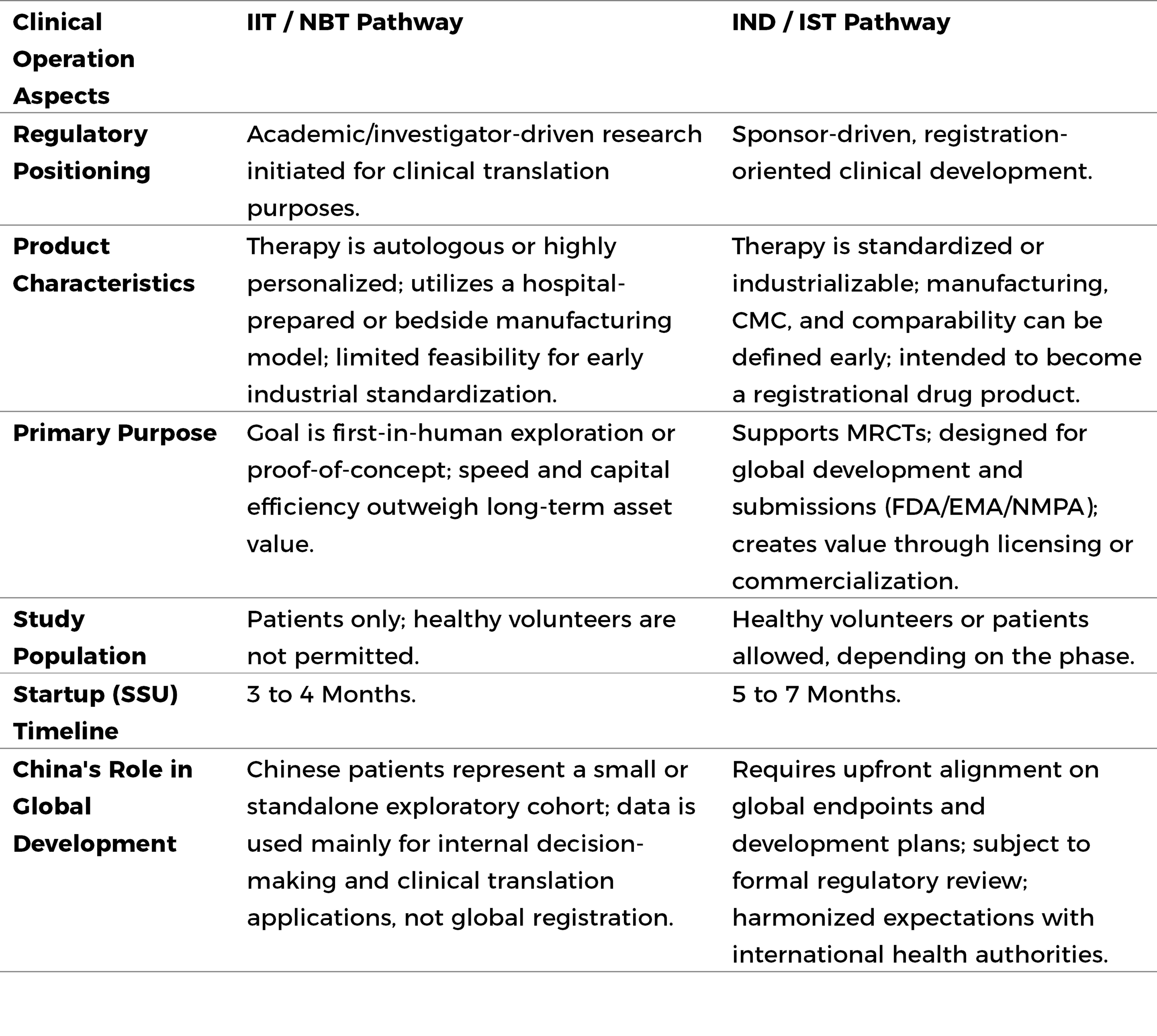
Selecting the
correct regulatory path is vital for maximizing capital efficiency and
long-term asset value. The following comparison highlights the key operational
and strategic differences:
Conclusion
China's newly
refined Dual-Track system provides global innovators with unprecedented
flexibility. Whether leveraging the accelerated 30-day IND route for
standardized global therapies or utilizing the NBT fast track for cutting-edge,
personalized treatments, understanding these parallel pathways is crucial for
success.
Tigermed provides end-to-end
support from discovery to clinical and is dedicated to be your trusted partner
for initiating clinical research in China, helping you navigate China’s complex
and opportunity-rich regulatory environment.
Download the PDF version: https://www.tigermedgrp.com/files/39b4f814fe86f66130494158f3058e56.pdf
Contact
Email: marketing@tigermedgrp.com
Website: www.tigermedgrp.com