Bringing a new medicine from laboratory research to regulatory approval involves coordinated work across multiple scientific, clinical, and regulatory disciplines. These activities may include nonclinical testing, regulatory planning, clinical operations, data analysis, safety surveillance, and medical writing.
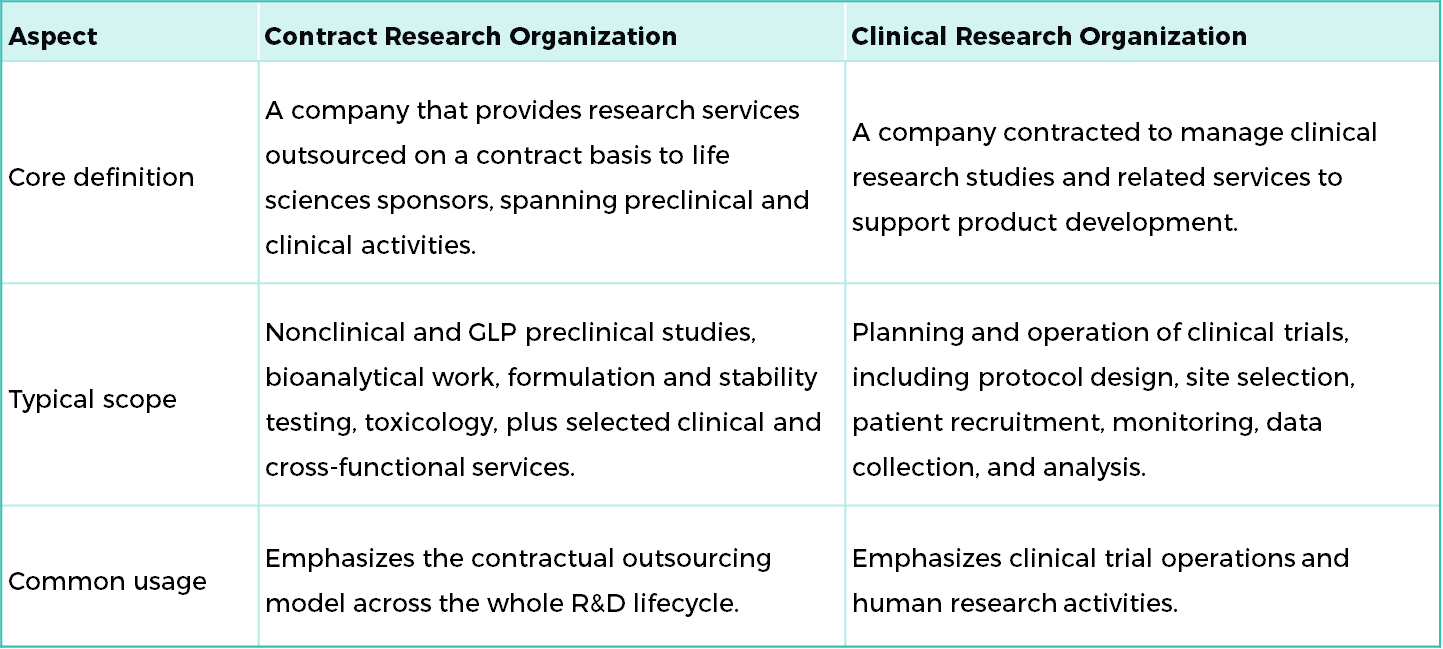
Within this multidisciplinary context, CRO is a term frequently used in drug development. So, what is a CRO? The acronym commonly refers to either a contract research organization or a clinical research organization. A contract research organization may provide services across different stages of the development lifecycle, while a clinical research organization generally focuses more specifically on clinical research and clinical trial activities.
What Does CRO Stand For?
In the life sciences literature, the acronym CRO is commonly explained in two ways:
1. Contract Research Organization 2. Clinical Research Organization
The NIH Seed Innovator’s Guide to Choosing a CRO describes contract research organizations as “specialized entities that offer research services on a contractual basis to innovators.” More recently, the ICH E6(R3) Good Clinical Practice guideline has adopted the broader term “service provider” to cover third parties that perform trial-related activities, defining it as “a person or organization (commercial, academic or other) providing a service used by either the sponsor or the investigator to fulfill trial-related activities,” with contract research organizations cited as one example.
Meanwhile, industry overviews and company resources often use clinical research organization to highlight a focus on managing phase I to phase IV clinical trials.
Why Are the Two Terms Often Used Interchangeably?
Several factors explain why the two meanings of CRO are often used interchangeably in practice.
— First, many large providers deliver both nonclinical and clinical services, so the distinction between contract research and clinical research becomes less important than the full service mix they offer.
— Second, authoritative sources such as Wikipedia describe CROs collectively as companies that support the pharmaceutical, biotechnology, and medical device industries through outsourced research services, whether preclinical or clinical.
— Third, industry associations and global providers also reinforce this flexible usage by referring to “clinical or contract research organization (CRO)” as a single concept when describing the outsourcing model.
As a result, when sponsors ask what a CRO means in everyday project discussions, they usually refer to any external research partner rather than strictly separating the two labels.
What Is a Contract Research Organization?
A contract research organization, or CRO, performs defined research or development activities for a sponsor under a contractual agreement. In regulated clinical development, this relationship can involve the formal transfer of certain sponsor obligations. Under 21 CFR 312.3 , the US Food and Drug Administration defines a CRO as “a person that assumes, as an independent contractor with the sponsor, one or more of the obligations of a sponsor.”
The exact responsibilities depend on the written agreement. They may include protocol development, investigator selection, study monitoring, data evaluation, regulatory documentation, or other specified activities. Under ICH E6(R3) , transferred activities are documented, while ultimate responsibility for participant protection and reliable trial results remains with the sponsor.
This model gives sponsors access to scientific expertise, trained personnel, established systems, laboratory capacity, or geographic coverage for a defined program. Potential benefits include flexible resourcing, specialist knowledge, consistent operating procedures, and coordination across multiple functions. Actual outcomes depend on provider suitability, project complexity, contractual clarity, and effective sponsor oversight.
Typical Scope of Services
A contract research organization may provide
one specialist function or support several development stages. Common service
areas include:
· Nonclinical research: pharmacology, toxicology, bioanalysis, drug metabolism,
pharmacokinetics, and safety assessment.
· Analytical
and formulation support: method development and
validation, formulation development, and stability testing.
· Clinical development: protocol support, feasibility, project management, study
monitoring, and trial closeout.
· Biometrics: data management,
biostatistics, statistical programming, and analysis outputs.
· Regulatory,
safety, and quality services: regulatory strategy,
medical writing, pharmacovigilance, audits, and inspection preparation.
· Post-approval
research: observational studies, real-world data programs,
and other evidence-generation activities.
Learn more about CRO
services across different stages of development: What Are CRO Services and How to Choose the Right CROCompany?
What Is a Clinical Research Organization?
A clinical research organization focuses on
the scientific, operational, and administrative work required to conduct
research involving human participants. The NIH SEED guide describes clinical
research organizations as providers engaged to manage clinical research filings
and the conduct of clinical trials.
A clinical CRO may manage an entire study or
selected functions. Its role often includes coordinating sponsors,
investigators, research sites, laboratories, ethics committees, regulators, and
other vendors. This coordination supports consistent execution, documented
responsibilities, and timely communication across study locations.
Typical Scope of Services
Clinical research services may
include:
· Protocol and
operational planning.
· Country and
site feasibility.
· Regulatory
and ethics submissions.
· Site
selection, qualification, activation, and management.
· Project
management and clinical monitoring.
· Participant
recruitment support.
· Data
management, biostatistics, and statistical programming.
· Medical
monitoring, pharmacovigilance, and medical writing.
· Study
closeout, final reporting, and inspection support.
Monitoring is one component of
trial oversight. It helps evaluate whether study conduct, records, and reports
align with the protocol, Good Clinical Practice, applicable procedures, and
regulatory requirements. Sponsor oversight remains necessary for all
transferred activities.
Tigermed’s CRO Services
Founded in 2004, Tigermed is a full-service CRO serving the global biopharmaceutical
and medical device industries. We provide integrated services tailored to
product research and clinical development needs, covering preclinical research,
early-phase clinical development, Phase II and Phase III clinical trials,
post-marketing studies, and real-world research. Our capabilities also include
medical writing, clinical monitoring, regulatory affairs, biostatistics and
data management, pharmacovigilance, quality assurance, central laboratory
services, and medical imaging. Supported by a global network spanning Asia
Pacific, Europe, the Americas, and Africa, with more than 11,000 employees and
over 180 offices and operational locations, we provide both local execution and
cross-regional coordination.
To learn more about Tigermed’s capabilities
or discuss your specific project requirements, development stage, and preferred
collaboration model, please contact our professional team.
*Disclaimer: This article
is compiled from publicly available information and is intended to introduce
general terminology and concepts related to Contract Research Organizations
(CROs). It is provided for general reference only and does not constitute
regulatory, legal, or professional advice.