Regulatory communication and documentation
compliance remain persistent challenges in clinical development. Global regulatory affairs
provides a structured approach to addressing these demands. It connects
development decisions, compliant documentation, and engagement with health
authorities across markets, supporting the product throughout its life
cycle—from clinical development through marketing authorization to
postmarketing safety monitoring.

What Is Regulatory Affairs Consulting?
Regulatory affairs consulting provides
scientific, regulatory, and operational guidance for the development,
authorization, and lifecycle management of medicines and other regulated
medical products. It helps sponsors interpret applicable laws, agency guidance,
and submission requirements, then translate product evidence and development
plans into a structured regulatory pathway.
In clinical development, global regulatory
affairs serves as a cross-functional discipline. It links nonclinical research,
clinical operations, biostatistics, pharmacovigilance, and chemistry,
manufacturing, and controls (CMC). This coordination helps ensure that clinical
trial documents, safety information, manufacturing data, and regulatory
submissions are accurate, consistent, and suitable for the intended market.
The role extends beyond obtaining an initial authorization.
Regulatory professionals can support authority interactions, submission
maintenance, post-approval changes, pharmacovigilance activities, and ongoing
compliance throughout the product life cycle. This lifecycle perspective is
particularly relevant in global development, where regulatory systems are
increasingly aligned through international standards but continue to differ in
legal requirements, local procedures, and evidence expectations.
What Services Does Global Regulatory Affairs Typically
Include?
The scope of global regulatory affairs services varies by product
type, development stage, and target market. In drug clinical development and
registration, these services commonly include:
· Regulatory Strategy and Intelligence Support: Assessing the regulatory landscape and potential gaps in target
markets; developing a global regulatory strategy, market entry sequence, and
health authority communication plan; and monitoring relevant regulations,
guidance, and regulatory practices.
· Clinical Trial Regulatory Support:
Preparing and managing INDs, CTAs, and other clinical trial applications;
reviewing core documents such as clinical trial protocols, Investigator’s
Brochures, and informed consent forms; and supporting amendments and trial
closeout-related activities.
· Marketing Authorization Submission Support: Assisting with the preparation and management of NDAs, BLAs, MAAs,
and other applicable registration submissions, as well as coordinating
supplementary information and review questions during the submission process.
· Health Authority Communication Support: Preparing meeting requests, briefing packages, and formal response
documents; and coordinating health authority inquiries, requests for additional
information, and related communication records.
· Post-Approval Regulatory Maintenance Support: Supporting coordination related to post-approval changes,
submission maintenance, and other ongoing regulatory activities.
The Roles and Responsibilities of Regulatory Affairs
Professionals
Regulatory affairs consultants and professionals guide the complex
journey of a drug from preclinical research to market, managing rigorous
testing, ensuring adherence to global standards, and supporting ongoing
compliance and monitoring after approval.
Their responsibilities not only help uphold industry integrity but
also contribute to the protection of public health.

Explore more about CRO services: What Are CRO Services and How to Choose
the Right CRO Company?
Knowledge Card
Key Clinical
Research Regulatory Agencies
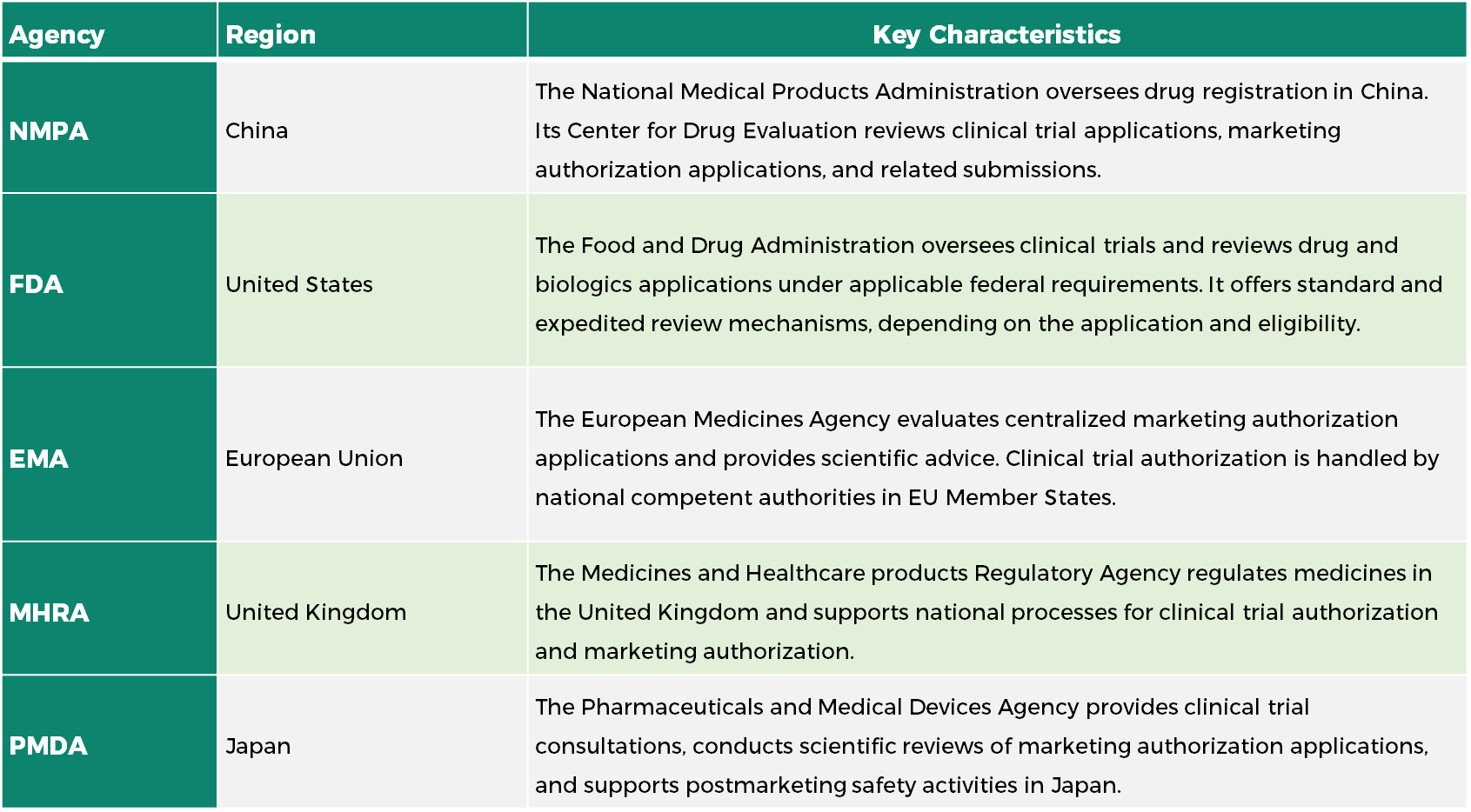
Each agency maintains distinct legal
frameworks, submission procedures, data expectations, and communication
processes. A global regulatory strategy for pharmaceuticals requires sponsors
to assess these differences early and plan regulatory activities accordingly.
Key
Regulatory Pathways and Submission Terms
| Concept | Definition |
|---|
| 505(b)(1) NDA |
A
stand-alone NDA containing full reports of investigations of safety and effectiveness
conducted by or for the applicant, or for which the applicant has a right of
reference.
—————————————————————————————————————— |
| 505(b)(2) NDA |
An NDA
that may rely partly on investigations not conducted by or for the applicant
and for which the applicant has not obtained a right of reference, where such
reliance is scientifically justified.
—————————————————————————————————————— |
BTD
(Breakthrough
Therapy Designation) |
An FDA
designation for a drug intended to treat a serious condition when preliminary
clinical evidence indicates that it may demonstrate substantial improvement
over available therapies on clinically significant endpoints.
—————————————————————————————————————— |
PRIME
(PRIority
MEdicines) |
An EMA
scheme that provides early and enhanced regulatory support for medicines under
development that target an unmet medical need.
—————————————————————————————————————— |
| Conditional Marketing Authorisation |
An EU
authorization route that may be granted before comprehensive clinical data are
available, provided that defined criteria are met and the applicant commits to
specific post-authorization obligations.
—————————————————————————————————————— |
DMF
(Drug
Master File) |
A
confidential submission to FDA containing detailed information about
facilities, processes, or articles used in drug manufacturing. A DMF is
reviewed in connection with an application that references it and is not
independently approved.
—————————————————————————————————————— |
CEP
(Certificate
of Suitability) |
A
certificate issued by EDQM confirming that a substance's quality can be
suitably controlled by the relevant European Pharmacopoeia monograph and any
necessary supplementary tests.
—————————————————————————————————————— |
ACTD
(ASEAN Common Technical
Dossier) |
The
ASEAN-agreed common dossier format for applications submitted to ASEAN
regulatory authorities for registration of pharmaceuticals and biologics for
human use. It standardises dossier organisation but does not replace individual
ASEAN Member States’ national requirements, assessments, or approval
decisions.
—————————————————————————————————————— |
GIFT
(Global
Innovative Products on Fast Track) |
An
MFDS programme designed to expedite regulatory review of eligible global
innovative medicinal products for life-threatening or serious diseases, including
cancers and rare diseases, to facilitate earlier patient access in South Korea.
—————————————————————————————————————— |
TFDA NDA
(New
Drug Application) |
A
marketing authorisation application for a new drug in Taiwan. TFDA identifies
new drugs to include new chemical entities, new routes of administration, new
therapeutic compounds, new indications, new combinations, and certain new
dosage forms, regimens, or strengths; applications may be submitted in CTD
format through physical submission, the online platform, or eCTD.
—————————————————————————————————————— |
| TFDA ANDA
(Abbreviated New Drug Application) |
An
abbreviated new drug application route administered by Taiwan’s Food and Drug Administration (TFDA). Applicants submit the applicable
registration materials, including the required application and regulatory
information forms and CTD-format documentation, through the specified
submission channels.
—————————————————————————————————————— |
| Hong
Kong “1+” Mechanism |
A Hong
Kong registration mechanism for pharmaceutical products containing new chemical
or biological entities. Subject to its requirements, an application may rely on
approval by at least one reference drug regulatory authority and must include
locally required clinical data and registration documentation.
—————————————————————————————————————— |
| Application for Registration of
Medicines (Western Medicines) in Macao |
The
registration application for Western medicines in the Macao SAR, administered
by the Pharmaceutical Administration Bureau. Applicants meeting the approval
requirements are issued a medicine registration licence.
|
Common Regulatory Challenges in Global Development and How
a CRO Partner Can Help
Challenge 1: Inconsistent Documentation Across
Jurisdictions
When sponsors file in multiple markets simultaneously, formatting
standards, required datasets, and supporting documentation can vary
significantly. A dossier accepted by the FDA may need restructuring for EMA or
NMPA review, and gaps in regional requirements often surface late, leading to
rejections or delays.
How a CRO partner can help:
· Conduct early-stage gap analyses through regulatory submission
consulting to identify documentation shortfalls before they become
obstacles.
· Map each region's specific requirements at the outset, building
a unified dossier framework for global regulatory submission.
· Apply life science regulatory intelligence & strategy to
reduce redundant work and align multi-region filings.
Challenge 2: Managing Regulatory Agency Communication
The format, timing, and content of pre-submission meetings,
scientific advice requests, and formal responses differ across agencies.
Missteps in agency communication can lead to misaligned expectations,
additional data requests, or review delays.
How a CRO partner can help:
· Prepare briefing documents and structure responses in each
agency's expected format, drawing on clinical trial regulatory services
expertise.
· Guide sponsors through FDA regulatory affairs consulting
protocols, including pre-IND and pre-NDA meeting preparation.
· Coordinate EMA regulatory affairs interactions with the
Rapporteur and member state reviewers.
· Anticipate agency questions and help sponsors present a clear,
well-organized case.
Challenge 3: Navigating Expedited Regulatory Pathways
Expedited programs such as BTD, PRIME, and Conditional Approval
offer potential timeline advantages, but eligibility criteria, supporting
evidence thresholds, and post-designation commitments vary by program and
agency.
How a CRO partner can help:
· Evaluate a sponsor's data package against each program's
criteria.
· Prepare designation requests aligned with agency expectations.
· Provide regulatory affairs services support to help sponsors
decide which expedited pathways to pursue and how to structure their
submissions.
Tigermed Global Regulatory Affairs Services
Tigermed provides
regulatory affairs consulting covering IND and NDA submissions, regulatory
strategy development, agency communication, gap analysis, DMF/CEP registration,
and lifecycle management. The scope of Tigermed's services extends to both
small molecules and biologics, including multi-regional clinical trial (MRCT)
regulatory coordination. With nearly 60 regulatory professionals experienced
across NMPA, FDA, and EMA submissions, Tigermed has supported over 4,200 drug registration projects for more than 1,000 clients globally.
Tigermed's global regulatory affairs services are designed to help
sponsors plan and execute regulatory submissions with clarity across
therapeutic areas and development phases. To learn more about how Tigermed can
support your regulatory needs, please feel free to contact our team.
Conclusion
Global regulatory affairs determines how clinical evidence is
documented, reviewed, and accepted across jurisdictions. For sponsors operating
in multiple markets, the quality of regulatory planning directly affects
submission outcomes, review timelines, and time to market access. With
global regulatory affairs capabilities and extensive registration experience,
Tigermed is committed to helping sponsors address complex regulatory
requirements and accelerate the journey of innovative products from development
to market access.
*
Disclaimer: This article is compiled from publicly available information and
is intended to provide a general overview of global regulatory affairs
concepts, processes, and related services in clinical development. It is
provided for general reference only and does not constitute regulatory, legal,
medical, or professional advice.