An innovative therapy can take many paths from the laboratory to patients worldwide.
It may begin in China, move through early studies in China and Australia, and later expand to the United States and Europe. Programs from the United States or Europe may also involve China early in their global development plans.
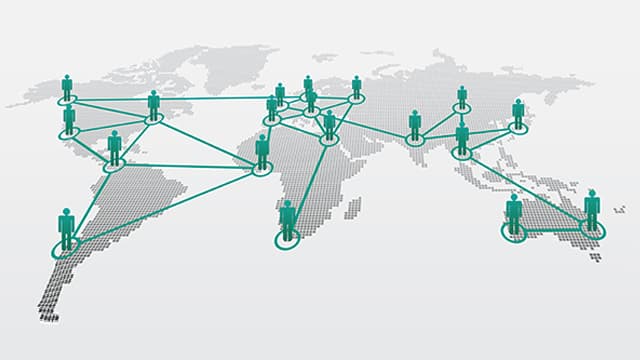
Innovation is no longer bound by one market. Talent, capital, patient populations, and clinical resources are increasingly connected across borders, creating a more integrated global R&D network.
The role of CROs is changing. As clients manage development across markets and stages, CROs must do more than execute individual projects. They need to connect markets and simplify global development.

Hao Wu, Co-President of Tigermed
In a recent conversation, Hao Wu, Co-President of Tigermed, shared his views on global R&D trends, the changing role of CROs, and how to coordinate development across regions. With more than 30 years of experience in the pharmaceutical industry and corporate management, he has held senior roles at Schering-Plough, Roche, Eisai, and SciClone International Pharmaceutical. He joined Tigermed in 2020 and has served as Co-President since 2021.
His experience in multinational pharmaceutical companies and professional R&D services has shaped his view of globalization and long-term client partnerships.
1 Global Innovation Now Moves Both Ways
Q1 What are your thoughts on the current changes in the global biopharmaceutical R&D landscape? How does this redefine the value of CROs?
I think the most important change is not that R&D is moving from one market to another. It is that global innovation resources are being redistributed.
China is no longer simply a contributor to global R&D; it is becoming a major source of innovation assets. In February 2026, Reuters, citing PharmCube, reported that licensing deals involving companies in Greater China reached a record US$137.7 billion¹ in 2025, nearly ten times the level in 2021.
We are also seeing overseas companies consider China earlier in their development planning. Their focus is moving beyond a traditional emphasis on commercialization or late-stage registration. They want to understand how Chinese patients, investigators, and clinical sites can contribute at different stages of development.
This is no longer just about Chinese companies going global or overseas companies entering China. Innovation assets and R&D resources are moving in both directions and increasingly across multiple markets.
For CROs, this means we need to look beyond project execution. We need to understand a product’s overall development goals, connect markets and resources, and turn cross-regional complexity into a practical development plan.
Q2 How has China's role in the global R&D system changed and how should we understand China's strengths today?
I do not think China’s strengths can be described simply in terms of cost, speed, or patient numbers anymore.
China is taking on a more strategic role in global innovation and clinical development. It has deep clinical resources, but just as importantly, its R&D ecosystem is becoming more mature.
The revised Drug GCP took effect in September 2026, strengthening data governance, participant protection, and quality management throughout the study process. Review and approval pathways for innovative drugs are also continuing to improve. As a result, China’s investigators, institutions, patients, and specialist teams across clinical operations, regulatory affairs, biostatistics, and laboratory services are becoming more closely connected to global R&D.
At Tigermed, we have provided clinical R&D services in China for more than 20 years, so we know this is not simply about access to resources. It is about matching the right resources to each disease area, adapting global protocols for implementation in China, and making sure local execution supports the product’s wider strategy.
I see China’s strengths shifting from individual resources to a more integrated R&D capability.
2 From Global Presence to Global Collaboration
Q3 As R&D becomes more global, what capabilities should a truly global CRO have?
I have always believed that global capacity and global capability are two different things. A broad geographic footprint is important, but it does not automatically make a CRO a global partner.
Every market has different regulations, ethics requirements, site practices, and recruitment conditions. A truly global CRO needs strong local expertise, but it also needs the ability to connect teams, processes, quality systems, and decisions across regions.
This is especially important in a multi-regional clinical trial (MRCT). Clients should not have to coordinate separate local teams themselves. Our role is to manage that complexity internally and provide one coordinated service model.
At Tigermed, we are continuing to build this capability. We now operate in 43 countries and have supported 184 MRCTs. Our U.S. business is expanding, while our teams and project experience in Europe and Asia-Pacific continue to grow.
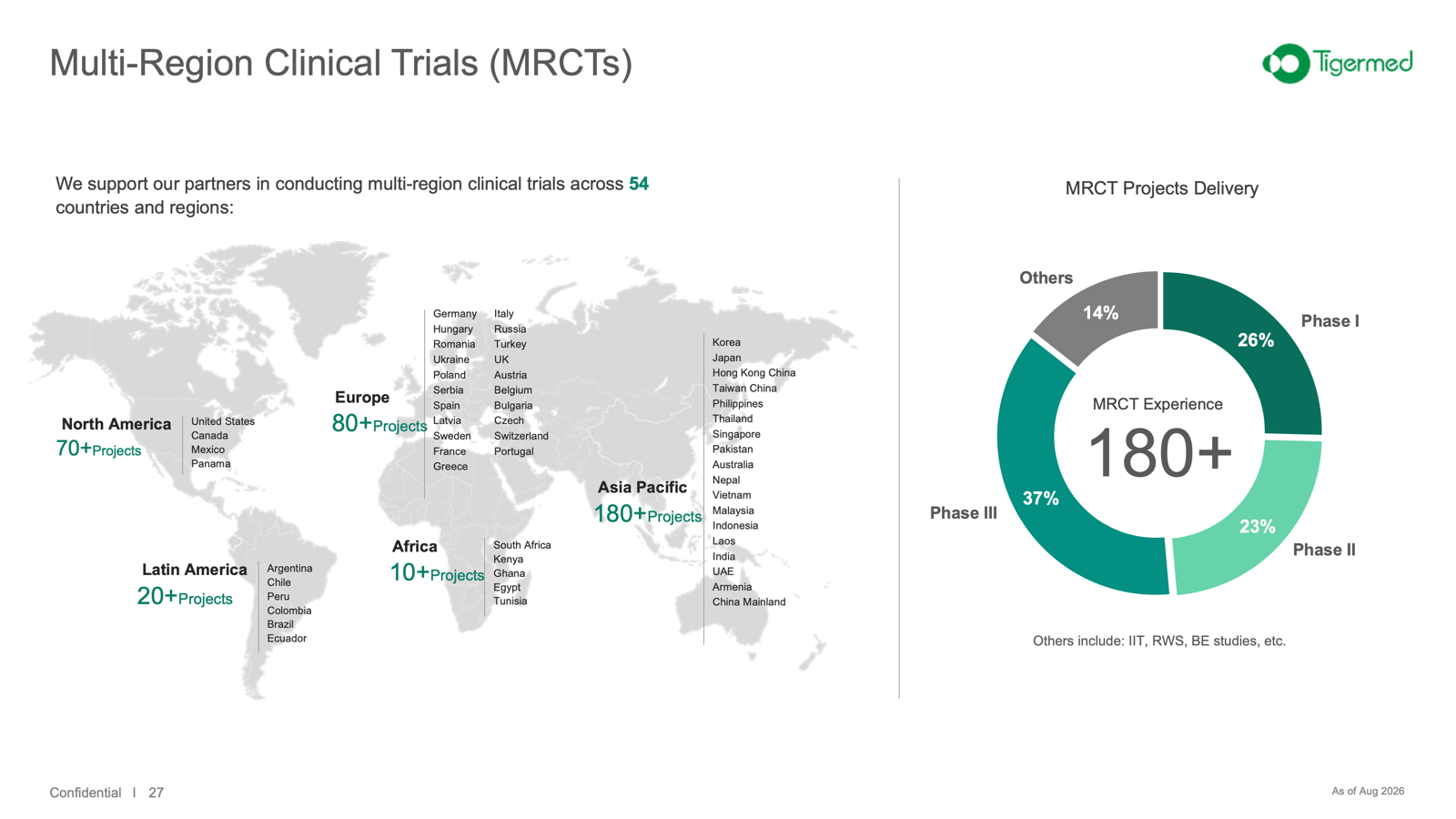
The most meaningful test of global capability is not where people are located. It is whether they can work effectively around the same client, product, and development goal.
Our aim is for clients to experience one connected service system: locally grounded, globally connected, and reliable in delivery.
Q4 How does Tigermed help MNCs and biotechs in the United States and Europe include China earlier and more effectively in global development?
I have seen a clear shift in how clients think about China. In the past, they often asked, “Can China do it?” Today, more are asking, “How can China fit into my global strategy?”
The issue is no longer simply whether China can run a trial. It is when China should be included, what role it should play, and how it can work alongside the United States, Europe, and other markets.
That is where we can add value. With deep China expertise and a global network, we help clients decide whether China should be included earlier in development, where activities can proceed in parallel, and how data generated in China can support the broader global plan.
Over the past 20 years, we have worked with all of the world’s top 20 pharmaceutical companies and supported more than 200 overseas companies with clinical trials in China. In the first half of 2026, we formed a strategic partnership with a leading multinational pharmaceutical company covering early-stage development. This reflects a broader shift: clients are asking CROs to contribute earlier, not simply execute a fixed protocol.
Q5 As Chinese innovative medicines reach global markets faster, what capabilities do companies need beyond the early stage of going global?
China is now the world’s second-largest biopharmaceutical R&D center, and its pipeline accounts for about 30%² of the global total. This means global development has become a much more immediate priority for Chinese innovators.
But going global is not about translating a China-based plan into English and repeating it elsewhere. The United States, Europe, Japan, South Korea, and Australia all have different regulations, clinical practices, investigator networks, and patient populations.
My view is that companies need to take a global perspective from the beginning. Product positioning, clinical strategy, evidence needs, and resource allocation should be considered before overseas development starts, not after.
At Tigermed, we bring local knowledge from global markets to Chinese innovators, while bringing more than 20 years of clinical development experience in China to the wider world. The goal is to help clients make decisions that reflect the realities of each market.
Q6 Tigermed has continued to develop clinical research centers. What value does this business bring to global clinical development?
China has a large patient population, experienced investigators, and extensive healthcare institution resources. But in global development, resources only create value when they are accessible, well coordinated, and reliable in delivery.
A clinical study depends on matching the right resources, activating sites, recruiting patients, and managing execution. If these steps are fragmented, sponsors still carry the burden of coordination.
That is why we have co-built six clinical research centers. They bring together healthcare institutions, investigators, sponsors, CROs and trial participants under a professionally managed operating model. We now offer services from Phase I to Phase IV, and new orders for this business grew 13% year on year in the first half of 2026.
For global clients, the value is better access to high-quality resources, faster site and investigator matching, and more consistent delivery. Over time, this helps turn China’s clinical resources into a sustainable capability for global development.
3 From Project Delivery to Long-Term Partnership
Q7 As clients globalize their R&D and business operations, how must Tigermed's organization evolve?
As our clients globalize, we need to make it easier for them to work with us across markets. They should not have to rebuild relationships or repeat the same requirements every time a project moves from China to the United States or Europe. That is our internal complexity to manage, not theirs.
In August 2026, we established an International Business Development Department to bring together business development resources across the United States, Europe, and other regions. We are also building a service model with one global point of contact and a coordinated internal response.
Whether a client first comes to Tigermed in China, the United States, or Europe, we can connect them to the right global resources, including medical experts, clinical operations, regulatory affairs, biostatistics and regional teams. Clients should experience One Tigermed, while we coordinate across regions behind the scenes. The value of a global CRO is fewer interfaces and less complexity, so clients can focus on their products and science.
Q8 A global CRO needs more than a business network. What is the role of talent and organizational mechanisms in Tigermed's globalization?
Global networks and systems are ultimately delivered by people. Clinical R&D requires daily decisions across countries and functions, so global collaboration depends on leaders and teams who can look beyond their own region, project, or short-term priorities.
That is why globalization also requires a global approach to talent, culture, and incentives. In 2026, Tigermed introduced an A-share restricted stock incentive plan for directors, senior management, and core technical and business staff, with long-term performance targets.
For me, its value goes beyond the incentive itself. It encourages key people to build client relationships, strengthen organizational capability, and invest in talent development over the long term. Clinical R&D involves long development cycles, and clients need partners that can provide stable support over many years.
Conclusion: Advancing Innovation Through Long-Term Partnerships
Bringing an innovative therapy to patients worldwide requires navigating multiple markets, making ongoing scientific and operational decisions, and coordinating effectively across regions. The role of a CRO is therefore expanding from delivering single projects to understanding development goals, connecting markets, and helping clients move R&D forward.
For Tigermed, being a global CRO is not simply about broader geographic coverage. It is about bringing global talent, experience, and resources together around the same development goal, and building long-term trust through shared problem-solving.
From a single project to global development, and from project support to building R&D systems together, Tigermed aims to work alongside clients for the long term and help more innovations reach patients worldwide.
References
1. https://www.reuters.com/sustainability/climate-energy/china-biotech-licensing-boom-hit-record-2026-pipeline-swells-2026-02-13/
2.https://www.nature.com/articles/d41573-026-00113-6