Key takeaways
A clinical development plan (CDP) turns a drug
candidate into an evidence-based route toward approval. It connects product
positioning, clinical questions, regulatory requirements, study designs,
decision points, timelines, and resources.
For a global program, the plan should also
address major markets,
including Europe, the United States, China, and other
Asia-Pacific (APAC) markets from the outset, reducing later conflicts over
endpoints, doses, populations, or datasets.
A CDP is the blueprint for showing that a
product's benefits outweigh its risks in a defined population. A protocol
governs one study; the CDP shows how the full program supports the intended
label.
ICH E8(R1) recommends designing quality
into studies by identifying factors critical to participant protection and
reliable results during planning.
A practical CDP usually defines:
● Target indication, population, value proposition, and desired label
● Evidence for dose selection, efficacy, safety, and benefit-risk
assessment
● The sequence from first-in-human (FIH) through confirmatory trials
● Regional regulatory interactions and submission milestones
● Go/no-go criteria, risks, dependencies, timelines, and budget
assumptions
An effective CDP should clarify what must
be learned, which study will answer it, and what evidence supports progression.
It must also test differentiation and feasibility: a valid study can still be
the wrong investment if its comparator, endpoint, recruitment plan, or likely
label cannot support the intended position.
What Should Be Aligned Before Clinical Protocol Design
Begins?
Protocol design should follow alignment on
product strategy, evidence gaps, and regional goals; otherwise, individual
trials may not form a coherent registration package.
| Input | Questions
to resolve |
|---|
| Target product profile | Who will receive the drug, for what indication, and
with what expected benefit? |
| Existing evidence | What do pharmacology, toxicology, CMC, biomarker, and
translational data support? |
| Competitive landscape | Where can the product differentiate on efficacy,
safety, dosing, access, or convenience? |
| Regulatory strategy | Which agencies, designations, advice meetings, and
approval routes matter? |
| Development constraints | What are the funding, manufacturing, recruitment,
timing, and geographic limits? |
Positioning determines which evidence is
valuable. A first-in-class asset may need mechanistic validation; a same-target
program may need a differentiated population, combination, dose, or safety
profile.
Regulatory goals turn that positioning into
evidence requirements. An accelerated approval hypothesis, for example, must
address the condition, unmet need, proposed surrogate endpoint, and
confirmatory evidence.
How Do You Build a Clinical Development Plan Step by Step?
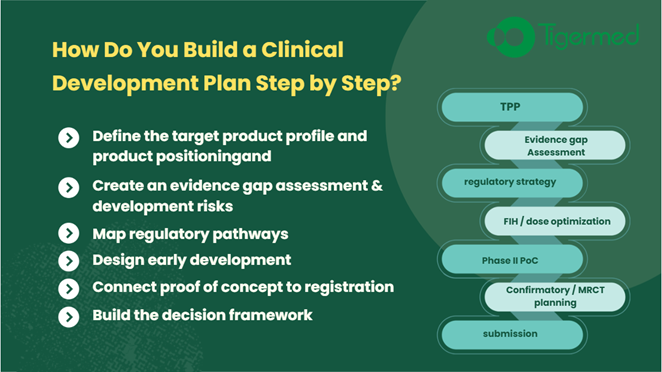
Build the CDP through six linked decisions:
1. Define the target product profile and product positioning: indication, population, setting,
route, desired claims, and differentiation.
2. Create an evidence gap assessment & development risks: integrate available data and identify uncertainties that threaten
progression.
3. Map regulatory pathways: plan agency interactions, special obligations, expedited routes,
and regional dependencies.
4. Design early development: select the FIH population, starting dose, escalation, safety
monitoring, PK/pharmacodynamic (PD) assessments, and activity measures.
5. Connect proof of concept to registration: define Phase II endpoints, dose-ranging, statistical assumptions,
confirmatory options, and multi-regional clinical trial (MRCT) needs.
6. Build the decision framework: add timelines, budget scenarios, feasibility, mitigations, and
go/no-go criteria.
Step 1: Define the Target Product Profile and Product Positioning
Start by defining the intended indication, patient
population, treatment setting, route of administration, dosing concept, desired
label, and expected differentiation.
▪ Clinical
development strategy and medical writing teams help translate the product
vision into a structured target product profile and an initial evidence plan.
▪ Regulatory
specialists assess whether the proposed indication and claims are realistic in
the target markets.
▪ Clinical and quantitative
pharmacology experts can also evaluate whether the available pharmacological
evidence supports the intended dose and treatment setting.
The output of this step is a clear description of what
the product is expected to become and what evidence will be required to support
that goal.
Step 2: Create an Evidence Gap Assessment &
Development Risks
Next, review the available nonclinical, clinical,
safety, PK/PD, biomarker, and competitive evidence to identify the
uncertainties that could prevent development from progressing.
▪ Clinical
development consulting brings the different evidence streams together.
▪ Clinical and
quantitative pharmacology teams assess exposure-response, dose, and
translational uncertainties.
▪ Medical
monitoring and pharmacovigilance specialists identify known and potential
safety risks.
▪ Data management
and biostatistics experts determine whether the existing data are complete,
consistent, and suitable for decision-making.
▪ Clinical
operations can contribute an early feasibility perspective by assessing whether
the proposed population, endpoints, procedures, and study locations are
practical.
The result should be a prioritized list of evidence
gaps, their potential impact, and the studies or analyses needed to resolve
them.
Step 3: Map the Regulatory Pathways
The third step is to determine how the program will
meet the requirements of the FDA, EMA, NMPA/CDE, and other relevant regional
authorities.
▪ Regulatory
affairs specialists lead the assessment of submission routes, agency meetings,
regional requirements, expedited pathways, and data acceptability.
▪ Medical writing
and clinical development strategy teams prepare briefing documents, development
summaries, protocols, and responses to regulatory questions.
▪ Data management
and biostatistics specialists help align the program with regional data and
analysis standards.
▪ Pharmacovigilance
teams consider safety-reporting requirements, while clinical pharmacology
experts address regional questions involving dose, PK/PD, ethnic sensitivity,
or bridging evidence.
The output is a coordinated global regulatory roadmap
that identifies common evidence requirements and justified regional
differences.
Step 4: Map Regulatory Pathways
The fourth step is to design the first-in-human and
other early-phase studies that will establish safety, tolerability, PK/PD, dose
range, and preliminary activity.
▪ Clinical
development strategy and medical writing teams turn the scientific objectives
into an executable protocol.
▪ Clinical and
quantitative pharmacology specialists support FIH dose determination,
escalation design, PK/PD assessments, exposure-response analysis, and
later-stage dose recommendations.
▪ Biostatistics
experts define the analytical approach and decision criteria.
▪ Clinical
operations and project management teams assess site feasibility, study
timelines, resources, and execution risks.
▪ Medical
monitoring and pharmacovigilance teams establish safety surveillance and
escalation procedures.
▪ Regulatory
affairs specialists support the required submissions and agency communications.
This integrated approach helps ensure that early
studies generate the information needed for a defensible go/no-go decision.
Step 5: Connect Proof of Concept to Registration
The fifth step is to translate early findings into a
Phase II proof-of-concept strategy and a credible path toward confirmatory
development.
▪ Clinical
development strategy specialists help select the indication, patient
population, comparator, endpoints, and potential differentiated pathway.
▪ Clinical
pharmacology and quantitative pharmacology teams interpret PK/PD and
exposure-response results to recommend doses and dosing regimens.
▪ Data management
and biostatistics teams support dose-ranging, sample-size assumptions, endpoint
analysis, and Phase II or Phase III design.
▪ Medical
monitoring and pharmacovigilance specialists evaluate whether the emerging
safety profile supports broader or longer exposure.
▪ Clinical
operations and project management teams test whether the proposed study is
feasible across the intended countries and sites.
▪ Regulatory
affairs and medical writing teams ensure that the resulting evidence plan can
support future agency discussions and registration submissions.
Step 6: Build the Decision Framework
Finally, convert the scientific strategy into an
operational roadmap with timelines, responsibilities, dependencies, risks,
budgets, and go/no-go criteria.
▪ Project
management coordinates activities across functions and regions.
▪ Clinical
operations translate the plan into site selection, study start-up, recruitment,
monitoring, and close-out activities.
▪ Data management
and statistical analysis provide the information needed to track evidence
generation and support decisions.
▪ Medical
monitoring and pharmacovigilance teams continue to evaluate benefit-risk
throughout development.
▪ Medical writing
and clinical development strategy teams update the CDP as new results emerge.
▪ Regulatory
affairs specialists assess whether protocol changes, new findings, or regional
requirements affect the overall submission strategy.
The completed CDP is a living decision framework that
coordinates key clinical development services[T3] [E4] around one product
objective. This is where an integrated CRO can add value: by keeping scientific
strategy, regulatory planning, study execution, safety oversight, and data
interpretation aligned from early development through registration.
How Should a Global CDP Address the US, Europe, APAC, and
China?
A global CDP should use one core evidence
strategy while anticipating legitimate regional differences. ICH E17 addresses
MRCT design, regional variability, population allocation, and consistency of
treatment effects.
| Region | Early Planning Focus |
|---|
| United States | FDA meetings, dose optimization, expedited programs,
and evidence for the intended label |
| Europe | EMA advice, EU trial requirements, pediatric planning,
endpoints, comparators, and benefit-risk evidence |
| China | NMPA/CDE communication, ethnic sensitivity, medical
practice, local data needs, and MRCT participation |
| Other APAC markets | Country-specific submissions, feasibility, standard of
care, site capability, and opportunities for early studies |
Early regulatory alignment should occur before
protocols are finalized. FDA pre-IND meetings and EMA scientific advice can
identify regional evidence gaps, while the NMPA’s adoption of ICH E5 and E17
supports evaluating China as part of the global program. Depending on ethnic
sensitivity, PK/PD, local medical practice, and feasibility, China may
participate in an MRCT or require dedicated clinical pharmacology or bridging
evidence.
What Should You Look for in a CRO Offering Cross-Regional
Strategy Consulting?
Choose a clinical research organization
(CRO) that connects scientific strategy, regional regulation, and execution.
Monitoring capacity alone does not demonstrate this ability.
Use this selection checklist:
● Clinical development consulting from FIH through registration
● Clinical pharmacology, PK/PD modeling, biostatistics, and medical
expertise
● Direct experience with FDA, EMA, NMPA/CDE, and relevant APAC
authorities
● Phase II, confirmatory, and MRCT design capabilities
● Accelerated-pathway and differentiated-development feasibility
analysis
● Local regulatory and operational teams working under a consistent
quality system
● Medical writing, regulatory, operations, safety, data, laboratory,
and post-market support
Ask candidates for a cross-regional gap
assessment and governance model defining decision ownership, local input, and
update triggers.
For a deeper understanding of CRO services and how to choose the right
CRO, see: What Are CRO Services and How to Choose
the Right CRO Company?
Which CRO Can Support an Early Global Strategy?
Tigermed is one CRO
that explicitly offers early clinical development strategy across a global
network with China speed and global quality. Our clinical development strategy consulting
includes individualized CDPs and protocols based on product characteristics and
registration goals.
| Sponsor
need | Tigermed's
stated capability |
|---|
| Early dose strategy | FIH dose determination, PK/PD interpretation, and
later-stage dose recommendations |
| Proof-of-concept planning | Phase II study design and development planning from
Phase I onward |
| Faster or differentiated path | Accelerated approval feasibility and competitive
differentiation analysis |
| China integration | Accelerated approval feasibility and competitive
differentiation analysis |
| Continuity into execution | Medical writing, regulatory affairs, operations,
biometrics, safety, and integrated supporting services |
Tigermed’s end-to-end
global CRO platform spans preclinical, clinical, integrated, and real-world
services across North America, China, APAC, Europe,
the Middle East, Africa, and South America.
This supports one strategy with locally
informed implementation. As of 2026, Tigermed has expanded
into 43 countries. In 2025, Tigermed was named to Forbes China’s list of Top 30 GO-INTERNATIONAL Brands.
How
Do You Turn a CDP into an Execution-Ready Global Roadmap?
Turn the CDP into an execution-ready
roadmap by linking each study to a decision, each decision to an evidence
threshold, and each region to the global product profile. Update it when key
assumptions change.
Three actions should come first:
1. Align the target product profile and regional ambitions.
2. Resolve the highest-impact evidence and regulatory uncertainties
before finalizing protocols.
3. Engage cross-regional drug development consulting early enough to
influence FIH and Phase II choices.
For programs spanning Europe, the United
States, APAC, and China, the right CRO can carry
one strategy from early evidence planning into compliant local execution.
Reference
[1] International
Council for Harmonisation, ICH E8(R1): General Considerations for
Clinical Studies
[2] International
Council for Harmonisation, ICH E17: General Principles for Planning
and Design of Multi-Regional Clinical Trials
[3] U.S. Food and Drug Administration, IND Application Procedures: Interactions
with FDA
[4] U.S. Food and Drug Administration, Project Optimus
[5] U.S. Food and Drug Administration, Accelerated Approval Program
[6] European Medicines Agency, Scientific Advice and Protocol Assistance
[7] National Medical Products Administration, Adoption of ICH E5 and E17
[8] National Medical Products Administration, Clinical Technical Requirements for Drugs
Marketed Overseas but Not Marketed in China